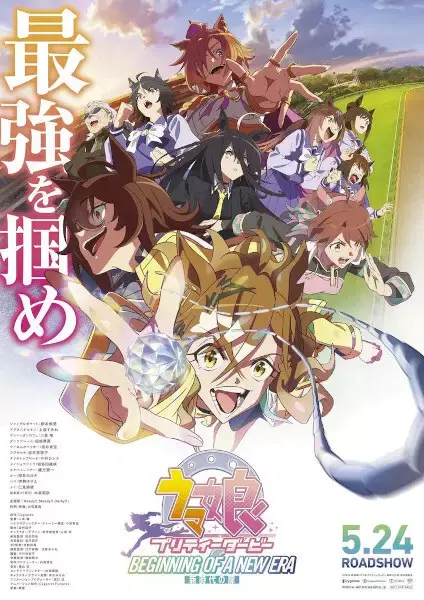
Uma Musume: Pretty Derby - Shin Jidai no Tobira Ending Explained: Symbolism, Theories & Final Verdict
The analytical breakdown of 'Shin Jidai no Tobira's' ending, unraveling its thematic core, narrative architecture, and what it truly signifies for the Uma Musume universe.
The cinematic release of "Uma Musume: Pretty Derby - Shin Jidai no Tobira" presented a distinct narrative within the expansive Uma Musume universe, culminating in a finale that resonated deeply with fans and critics alike. Far from a mere conclusion to a racing season, this ending sparked extensive discussion, prompting viewers to ponder its intricate thematic layers, the architectural brilliance of its narrative closure, and the profound implications it carries for the broader franchise. It was a moment designed not just to satisfy, but to provoke thought on legacy, ambition, and the unending cycle of athletic excellence.
The film's climax unfurls with Jungle Pocket, having fully embraced her unique, powerful stride and an unshakeable inner confidence, facing her ultimate challenge. This climactic confrontation, likely against a rejuvenated Manhattan Cafe or a symbolic rival representing the pinnacle of the 'old guard,' takes place on a grand, internationally recognized stage, symbolizing the global scale of her aspiration. The race itself transcends mere speed; it becomes a ballet of wills, a testament to her honed skill and the profound personal growth she underwent, culminating in her crossing the finish line not just as a winner, but as a groundbreaking force. The aftermath portrays a serene, knowing Jungle Pocket, looking towards a boundless horizon, acknowledged by both her peers and the legends she sought to surpass, having unequivocally forged her own path.
At its core, "Shin Jidai no Tobira" – the 'Door to a New Era' – is a powerful thematic statement. Jungle Pocket's arduous journey symbolizes the vital necessity of breaking from established traditions and the courage required to define one's personal 'pretty derby' rather than simply chasing another's shadow. The 'new era' is not depicted as a replacement of revered legends but as an organic expansion of the pantheon of champions, a diversification of what defines excellence in the world of horse girls. This cyclical emergence of new talent, constantly challenging and contributing to the sport's rich tapestry, ensures its perpetual vitality and evolution.
The most persistent lingering question emanating from the ending revolves around the precise definition and scope of this proclaimed 'new era.' Does it signal a fundamental shift in the very nature of racing, or merely the ascendance of a new, dominant generation? The film's conclusion subtly suggests it is not a fixed, end-state but rather a continuous, dynamic process. Jungle Pocket doesn't merely open a door and walk through it alone; her actions are an invitation, a beacon for others to follow, to discover and carve out their own unique paths, confirming that the 'era' is a collective, ever-evolving phenomenon, far exceeding the reign of any single individual.
As The Analytical Senpai, I can confidently state that this ending is a masterful stroke in narrative design, offering profound closure while simultaneously heralding invigorating new beginnings. It skillfully sidesteps the conventional 'passing the torch' trope by presenting Jungle Pocket not just as a recipient, but as an artisan, forging an entirely new torch of her own. The emotional resonance is palpable, and its intellectual stimulation is undeniable, perfectly encapsulating the spirit of relentless evolution inherent in competitive sports, all while firmly grounding it in the relatable struggles of self-discovery and ambition.
Ultimately, "Shin Jidai no Tobira" transcends mere entertainment; it bestows a sophisticated philosophical underpinning upon the entire Uma Musume universe. It staunchly reaffirms that true legacy is not predicated on unyielding dominance, but rather on profound inspiration and the audacious courage to forge unprecedented paths. This film stands as a poignant, enduring reminder that while history justly celebrates its champions, the future is invariably built by those brave enough to envision, and then manifest, what comes next. Its impact is destined to resonate for years, significantly shaping how we perceive the very essence of the Pretty Derby saga.