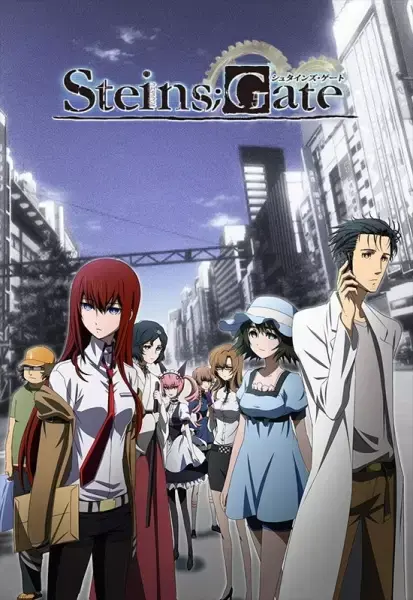
Steins;Gate Ending Explained: Causality, Convergence, and the Promise of a Perfect Future
Dive deep into the intricate temporal mechanics and profound thematic resolutions of Steins;Gate's acclaimed finale, deciphering its ultimate meaning.
The ending of Steins;Gate remains one of the most meticulously crafted and emotionally resonant conclusions in anime history, sparking fervent discussion among fans and critics alike regarding its intricate temporal architecture and profound philosophical implications. After twenty-three episodes of heart-wrenching paradoxes, agonizing sacrifices, and the relentless pursuit of an ideal future, the final episode, 'Open the Steins Gate,' delivered a resolution that was both narratively satisfying and thematically rich. It presented not just a happy ending, but a deeply earned one, cementing the series' status as a masterpiece of speculative fiction and emotional storytelling.
In the climactic moments of the finale, Rintarou Okabe, guided by a D-Mail from his future self, undertakes 'Operation Skuld' to save Kurisu Makise without altering the chain of events that leads to SERN's dystopian future. He returns to July 28, 2010, armed with the knowledge of how to trick his past self and, crucially, to genuinely save Kurisu from her fated death at the hands of her father. This involves creating a diversion that causes him to believe he has failed, mimicking the first time he witnessed her 'death,' while simultaneously ensuring her survival through a precise, non-lethal intervention. The blood he sees, the scream he hears – all are carefully orchestrated illusions to protect the timeline's convergence.
The profound symbolism of the 'Steins Gate' world line itself lies not merely in its status as a 'happy ending,' but as a convergence point where the seemingly irreconcilable paradoxes of both Mayuri's death and Kurisu's death are averted, and SERN's future dystopia is prevented. It represents a reality achieved through immense suffering and self-sacrifice, where free will, guided by knowledge and compassion, ultimately triumphs over the deterministic forces of attractor fields. The final scene, with Kurisu's reunion with Okabe, signifies the successful establishment of this delicate equilibrium, a reality where both his past and future selves coexist in a stable, ideal configuration, liberated from the previous tragic loops.
One of the biggest lingering questions for many viewers revolves around the exact mechanics of how the 'Steins Gate' world line truly 'exists' when it seemingly contradicts established attractor field theory. The answer lies in its unique nature: it is not simply another world line within the Alpha or Beta fields, but a deviation from them entirely, a third, stable path. It is a world line where the conditions for both the SERN dystopia (via Kurisu's death and the development of the time machine) and the Mayuri death attractor field are sufficiently altered to prevent their convergence, demonstrating that a sufficiently large, conscious intervention can indeed forge a path outside the predicted 'fate' of the attractor fields. Okabe's future self explicitly states this, implying the Steins Gate is a realm where the future's ability to influence the past is perfectly balanced, allowing for a novel outcome.
As The Analytical Senpai, I must conclude that the ending of Steins;Gate is nothing short of a narrative triumph. It masterfully weaves together intricate temporal mechanics with deeply human emotional stakes, culminating in a resolution that feels both earned and profoundly satisfying. The intellectual gratification of witnessing Okabe's final, ingenious plan execute flawlessly is matched only by the emotional catharsis of seeing him finally achieve peace after enduring unimaginable suffering. It solidifies the series' architectural brilliance, proving that even amidst the chaos of causality, intelligent design and unwavering resolve can forge a path to genuine salvation.
The overall impact and legacy of Steins;Gate's ending are monumental, influencing subsequent time-travel narratives and setting a high bar for thematic resolution in science fiction anime. It showcased how a narrative rooted in complex scientific concepts could simultaneously deliver a deeply personal and emotional journey of self-discovery and sacrifice. By providing a truly satisfying conclusion that honored its characters' struggles and the audience's investment, Steins;Gate cemented its place as a genre-defining work, proving that even within the boundless possibilities of time travel, a perfectly constructed narrative can deliver a timeless tale of hope and ingenuity.