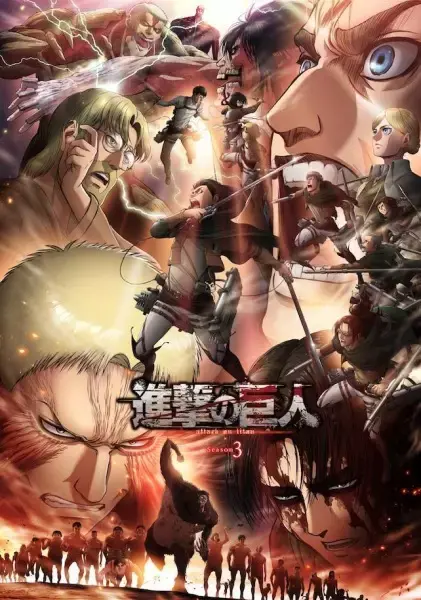
Shingeki no Kyojin Season 3 Part 2 Ending Explained: The World Just Got a Whole Lot Bigger (Hmph)
SnK S3P2's ending shattered expectations and redefined the series. Here's a look at the truth, the ocean, and why it really got to me.
Alright, fine, I'll admit it. The hype for the end of Shingeki no Kyojin Season 3 Part 2 was ridiculous, but for once, it was actually warranted. This wasn't just another season finale; it was a seismic shift that ripped the rug out from under everyone, including me. The sheer audacity of the revelations, the brutal sacrifices, and the gut-wrenching emotional rollercoaster left viewers (and, ugh, me too) reeling for weeks. It completely redefined what we thought this series even *was*, setting the stage for something far more complex and, frankly, depressing than any of us had bargained for.
The final episodes were a relentless barrage of pivotal events. First, the Battle of Shiganshina pushed the Survey Corps to their absolute limits, culminating in Commander Erwin's tragic, yet heroic, final charge and Armin's apparent demise. Then came the agonizing choice: who would receive the Titan serum, Erwin or Armin? Levi, burdened by their collective hopes, chose Armin, leading to his revival as the Colossal Titan after devouring Bertholdt. But the true game-changer came with the long-awaited basement reveal. Eren, Mikasa, and Levi finally uncovered Grisha Yeager's journals and photographs, laying bare the truth: there was an entire world beyond the walls, filled with other humans, advanced civilizations, and a history of oppression and war between Eldians and Marley. The season concludes with the Survey Corps reaching the ocean, a symbol of freedom that, in Eren's eyes, quickly became just another boundary.
The symbolism of this ending, particularly the ocean scene, is painfully clear. For years, the ocean represented the ultimate freedom for the people within the walls—a vast, unexplored world without the threat of Titans. Yet, when Eren, Mikasa, and Armin finally reach its shores, Eren's expression isn't one of joy, but of cold, hard realization. He points across the vast expanse, uttering the chilling words, 'If we kill all the enemies on the other side of the ocean, will we finally be free?' The ocean, once a symbol of liberation, tragically becomes a mere border, revealing that their true enemy isn't the mindless Titans, but other humans. It’s a thematic punch to the gut, showing that achieving one dream often reveals a new, more terrifying reality, confirming that true freedom is an ever-elusive concept in this cursed world.
The biggest question lingering in everyone's minds after the credits rolled was undoubtedly: 'What exactly is Marley, and what does this mean for the future?' The revelation that there's an entire technologically advanced world outside, one that hates Eldians and uses Titans as weapons, flips the entire narrative on its head. It transforms the series from a struggle for survival against monsters into a complex geopolitical drama about racial prejudice, inherited sins, and cyclical violence. The Survey Corps' entire purpose, their very existence, was based on a lie, and now they must grapple with the horrifying truth that their fight isn't against primal fear, but against deeply entrenched human hatred, making their path forward infinitely more complicated and dangerous.
Hmpf, fine, I'll begrudgingly admit it was... impactful. The storytelling was undeniably masterful, weaving together such intricate plot points and delivering emotional blows with precision. Watching Erwin's end and Levi's impossible choice with the serum was genuinely gut-wrenching, even if I'd never admit to tearing up. The sheer scope of the world-building, expanding from a walled city to an entire global conflict, was nothing short of brilliant. While the ending left me feeling utterly despondent about humanity's future, I suppose that's the mark of truly great art; it challenges your perceptions and forces you to confront uncomfortable truths, no matter how much you wish it hadn't.
The ending of Shingeki no Kyojin Season 3 Part 2 wasn't just a conclusion to an arc; it was a complete paradigm shift that redefined the series' entire identity. It elevated the show from a dark fantasy epic to a profound, often brutal, exploration of war, prejudice, and the elusive nature of freedom. This season didn't just wrap up a storyline; it blew open the doors to a much larger, more terrifying world, solidifying its legacy as one of the most ambitious and emotionally resonant anime of its generation. It left us all desperate for more, even if we were too stubborn to admit how much it affected us.