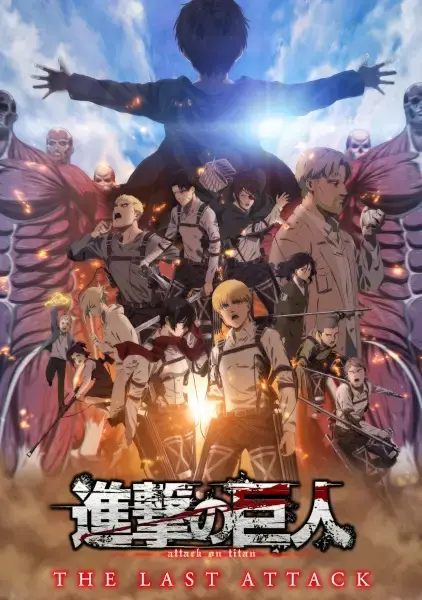
Shingeki no Kyojin Movie: Kanketsu-hen - The Last Attack Ending Explained: Symbolism, Theories & Final Verdict
Dive deep into the complex, divisive ending of Attack on Titan. The Analytical Senpai breaks down its symbolism and ultimate meaning.
The grand narrative of 'Shingeki no Kyojin,' a saga built upon layers of mystery, brutality, and profound philosophical inquiry, finally concluded with 'Kanketsu-hen - The Last Attack.' This cinematic event, consolidating the epic finale, dared to deliver an ending as polarizing and thought-provoking as the series itself. It was an ending that shattered expectations, not by offering definitive closure, but by confronting viewers with the enduring, cyclical nature of human conflict and the tragic weight of choice.
The final act sees the full unraveling of Eren Yeager's catastrophic plan, 'The Rumbling,' as the unified Alliance confronts him in a desperate battle for the fate of the world. Through the Paths, Eren engages in a deeply revealing conversation with Armin, disclosing his true motivations: his love for his friends, his innate desire for absolute freedom, and his tragic acceptance of the predetermined path that led him to annihilate 80% of humanity. Ultimately, Mikasa's agonizing decision to kill Eren, driven by love but sacrificing the source of her pain, provides the catalyst for Ymir Fritz's long-sought liberation, thus ending the curse of the Titans and restoring all Eldians to human form. The world, scarred but not entirely lost, begins a fragile journey towards rebuilding, though the seeds of future conflict are clearly sown.
At its core, the ending of 'Attack on Titan' is a poignant exploration of the inherent human struggle between freedom and determinism, and the inescapable cycle of hatred. Eren, despite his overwhelming power, remains a slave to his past, his future, and his very nature, a tragic figure caught in the inexorable flow of history. Mikasa's act of love and sacrifice transcends Ymir's ancient trauma, suggesting that true freedom is found not in power or revenge, but in the courage to break cycles of suffering. Yet, the series refuses a facile happy ending; the post-credits scene, depicting the passage of centuries and the return of a mysterious tree with a familiar cave, powerfully symbolizes the enduring nature of conflict and humanity's perpetual rediscovery of destructive power.
The biggest lingering question many viewers grappled with was: 'Did Eren truly achieve his goal?' The answer is profoundly complex and undeniably tragic. Eren’s stated goal shifted over time, from destroying all Titans to protecting Paradis, and finally to ensuring his friends lived long, free lives, even if it meant becoming the 'devil' of the world. While he succeeded in securing a temporary reprieve for his loved ones and ended the Titan curse, he did so at an unimaginable cost, failing to achieve lasting world peace. His actions merely reset the stage, postponing the inevitable and proving that even a single-minded pursuit of 'freedom' can lead to the most horrific forms of oppression. He became the monster so his friends could be heroes, a twisted form of love and sacrifice that left a bitter taste.
As 'The Analytical Senpai,' I find this ending to be a masterful, albeit melancholic, narrative construction. It is an ending that refuses to pander, instead opting for a profound, almost sociological commentary on the human condition. While some may find its lack of a clean, triumphant resolution unsatisfying, its thematic courage is undeniable. It challenges the very notion of 'good' and 'evil,' forcing us to grapple with the gray areas of morality and the inevitability of conflict. It’s an ending designed to provoke thought and discussion for years to come, a testament to its intellectual ambition rather than a failure of execution.
The ultimate impact and legacy of 'Shingeki no Kyojin' cannot be overstated. By delivering an ending that adheres to its brutal, deterministic worldview rather than betraying its core themes for facile fan service, the series solidifies its place as a modern classic. It is a work that transcends mere entertainment, becoming a cultural phenomenon that will be studied and debated for its intricate plot, complex characters, and unflinching examination of war, prejudice, and human nature. The final attack was not just against the Titans or the world, but against our preconceived notions of what an epic fantasy conclusion should be, ensuring its lasting mark on the annals of anime history.